Tuesday

Let's trade foods!


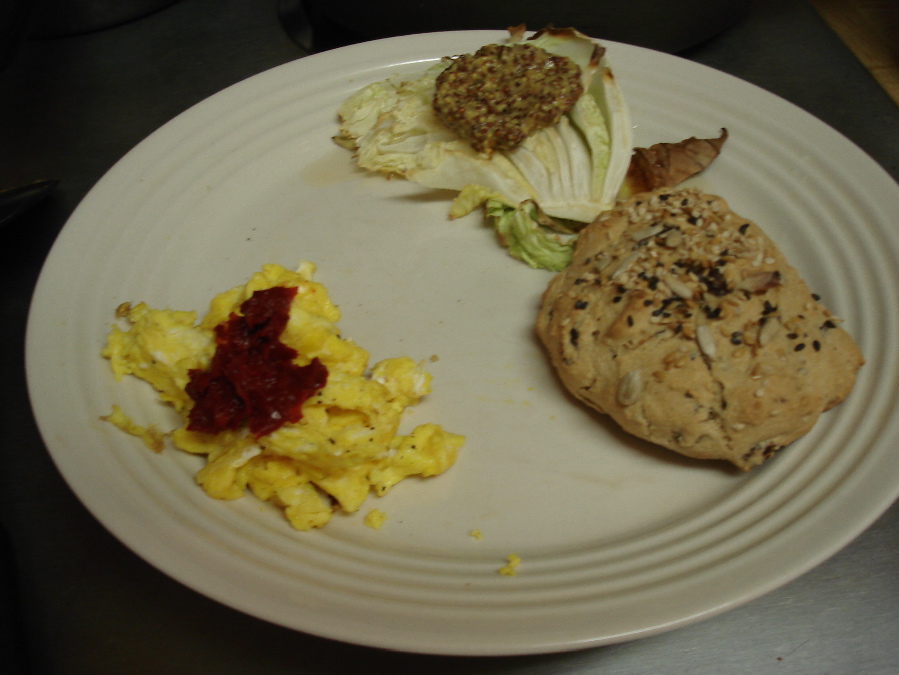
We maintain our large freerange flock, so we can to eat eggs all year, there is almost at least a few hens laying even in the dark of winter.  At other times of the year the number of eggs goes up to around 30 a day, and we find ourselves craving other types of food. 


We figured other people out there might be in a similar situation, but with some other food items, that they produce, or have an abundance of, and that they might like to trade for our hens eggs.  

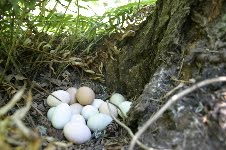
Our hens produce these fantastic eggs, If you are interested in trying them and want to play along, here is what we are proposing. 

We send a box of 48 eggs, and you send a box of something else, either from our list or you can  email us  to suggest a trade. You get great eggs in the mail, fun for you.  We get a variety foods in the mail that are hard for us to come by, which is fun for us, since we are not close to town, and are tied down on the farm most of the time feeding, and exercising the chickens.


We would like to trade these eggs for Asian market food items like:

Short Grain Sticky Sweet Brown Rice 
Whole Peeled Dried-Chestnuts

Reddish Purple Asian Sweet Potatoes 
Kadoya Sesami Oil (in the 56.oz can)

Smoked Mussels (vacuum packed)

Smoked Oysters (vacuum packed) 
Whole Dried Fish with the heads on (especially pollack)
Whole Dried Squid
Sticky Rice Cakes

Fried Fish Cake


But we are open to a wide variety of other foods:


Cashew Nuts

Jerky
Smoked Fish

Homemade Sausages
Good cheeses, (not American Process, etc)

Avocados
Caviar . . .


We send the eggs by Priority Mail, in the Portland area they arrive overnight, Two days to most hub cities and three to the farther reaches.


We do all we can to make sure the egg shells are as hard as possible, and pack them carefully, still a few may get cracked in transit, If you are cool with this, then we can play, remember this is all just for fun.  Part of the fun is seeing how many eggs make it.

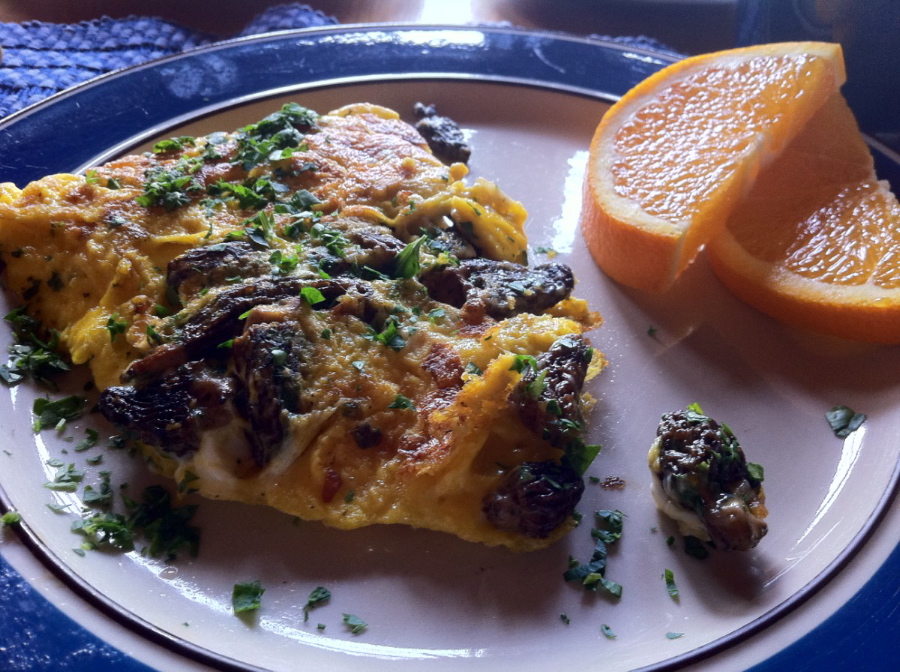
Also, We love to see what people do with the eggs we send them,
Send us pictures , and reviews, of the dishes you prepare with the eggs,  and we will post them on the blog.

How these eggs get to be fantastic.


  The eggs come from a small flock of chickens, who browse freely in the  forest all day.
Browsing for food is great exercise for chickens and is important for their health and fitness, which positively affects the quality of the eggs.
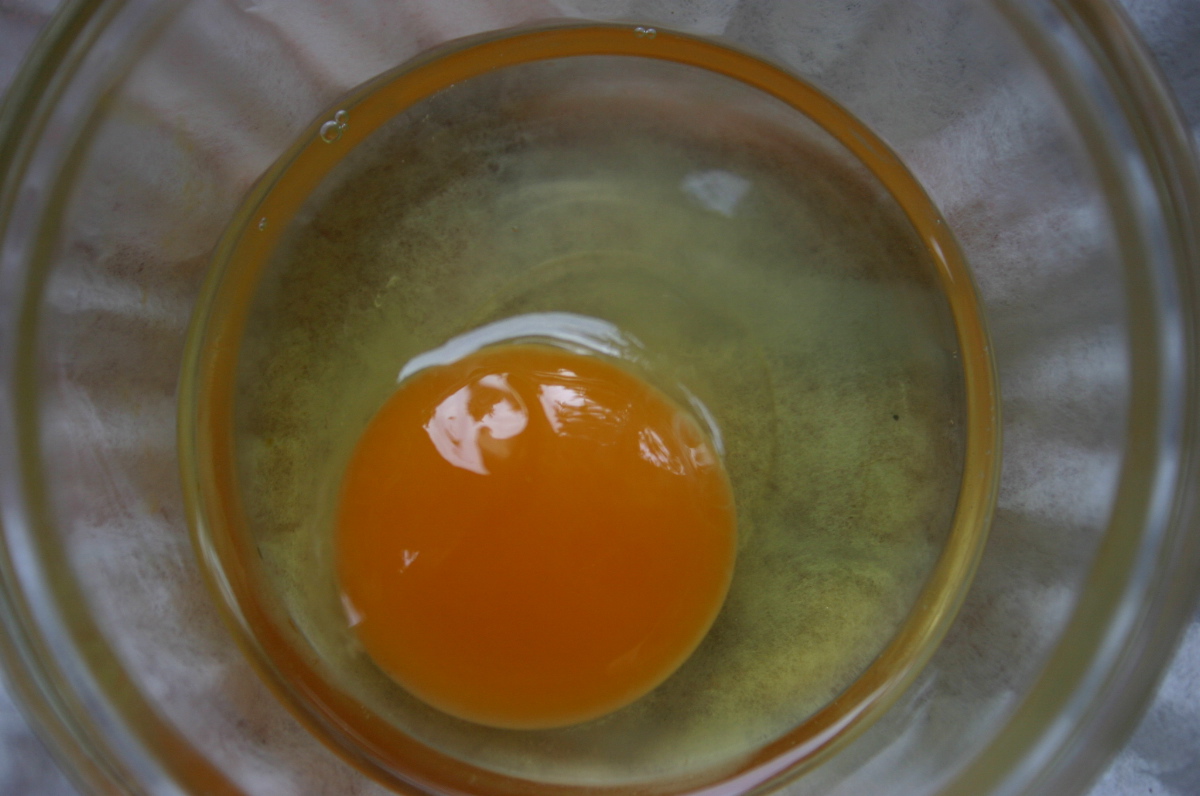
Our hens browse in a forest of Oak, Fir, and Maple trees. We keep the flock small, so the forest is able to regenerate, and continue to contribute to the diets of the hens. Instead of using fixed feeding stations we "Forest Feed" them their grain ration by scattering whole grains and seeds on the forest floor.  While eating their grain on the forest floor the chickens find natural chicken foods like, mosses, lichens, bugs, worms, and dirt to eat in combination with the seeds and grains they are eating. We want the chickens to scratch and peck for most of their food, because we believe that the exercise hens get scratching in the woods for their food is almost as important to egg quality as what they eat. Eating slowly and exercising promotes better digestion, so the hens can pass the food's nutrients to the eggs. It also seems that the hens that spend more time scratching around in the woods produce harder shells, with deeper yellow yolks. 


See our  food blog  to see other examples of the kinds of things we like to eat, feel free to email and ask us, if we might like to trade for what you've got.


(Please send us a photo of the food you want to trade. . . . and please no cookies, candies, baked goods, etc., we need to watch those carbohydrates.)

Monday

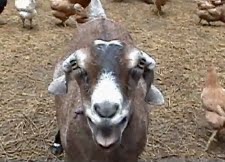
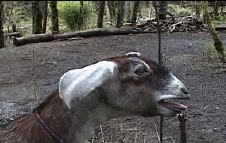
Gunner the Buck


Gunner is a young buck who is staying here to do his job. 


Rue Dee and Happee both think he is cute. 


They have been taking him to all their favorite places.
 

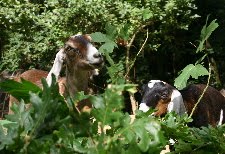
They visit the meadow to browse on the grasses and tangy blackberry leaves.


Happee took him to the woods to nibble on Oregon Grape, but Gunner and Rue Dee would rather smooch.


They all seemed to enjoy the car hood buffet, there were three kinds of hay.


The three of them all enjoy a rest on the trampoline bed.


Rue dee and Gunner actually found that the trampoline allowed them to overcome a height and weight difference that was making their union difficult. (Rue Dee is heavier than Gunner so she sinks lower in to the canvas, and the bounce gave Gunner the extra lift he was needing)


Rue Dee and Gunner are really quite taken with each other.


Saturday

Winter Garden

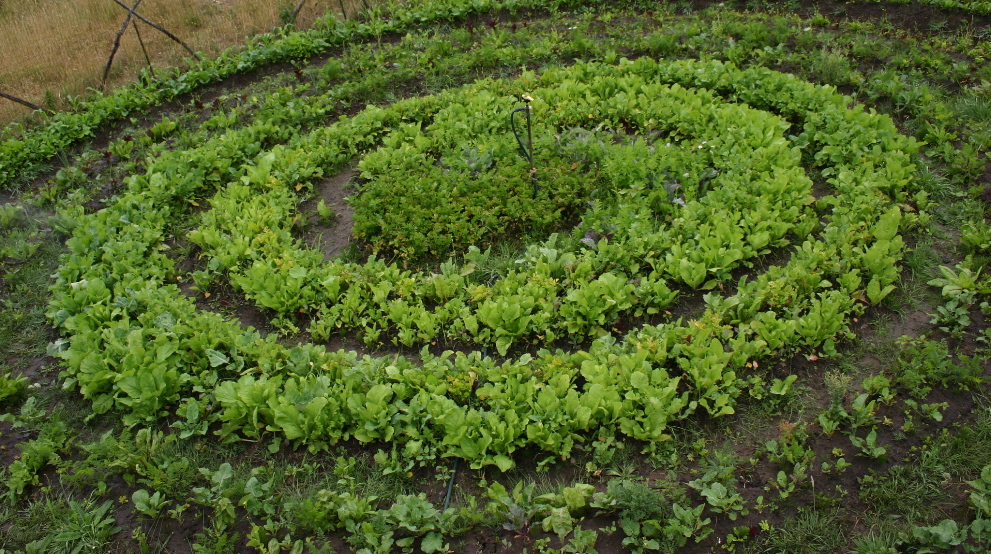
The first picture was taken in September, it was our second summer planting.
Mostly "Dinosaur Kale" which was new to us, and turned out to be a mild flavored. dark green. tender yet hardy Kale, that is good both as a salad green and for steaming. We also mixed some Swiss Chard into the garden.
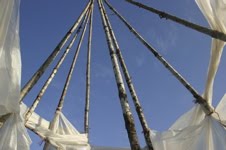
In December we decided to erect a tent around the garden to keep it warm, temperatures in the 20's  were expected. 

For awhile after the really cold weather hit, we were afraid to go down to look at the garden.
We imagined wilted, and rotting vegetable goo would be waiting to greet us,
But we were really pleased when finally we did go down to visit the plants.

They were doing quite well, and have saved us many trips to the grocery store, which is a 10 mile drive.
So we saved on both Bio-Diesel, and on our grocery bill.


The Green Onion and Leek patch survived, without a cover.
The best part is we are getting to eat super fresh vegetables all year round now.
and we don't need to go any farther then the meadow to get them.

Sunset

Friday

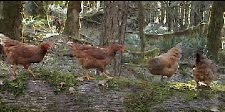
Flying Chickens !


They fly through the air with the greatest of effort!

Saturday

Kelp Meal is good for chickens and goats

By FASTILY (I created this work entirely by myself.) [CC-BY-SA-3.0 (www.creativecommons.org/licenses/by-sa/3.0) or GFDL (www.gnu.org/copyleft/fdl.html)], via Wikimedia Commons

http://upload.wikimedia.org/wikipedia/commons/d/d0/KelpforestI2500ppx.JPG
Kelp contains as many as 72 Trace Minerals. Sea water is full of minerals, because the Ocean covers around two thirds of the earths surface and rubs against a lot of rocks.  That being the case it would seem reasonable that kelp would contain a nice mix of many the minerals available on the planet.  Our chickens and goats will get their trace minerals from the kelp we feed them, and we will get our trace minerals from their eggs and milk, also, our garden will benefit from kelp enhanced chicken and Goat manures in the compost that we use to augment our soil.
We noticed a 50 lb. bag of Kelp Meal at our local feed store and thought it might be good to add a little seaweed to our diets.  We got the bag home and opened it, seaweed meal is dark rich green with little light green specks and is about the consistency of course ground pepper.


If you look really close at the grains of kelp, you can still tell that it is kelp by the surface texture of the granules.  (click the image to see it bigger)

We decided to prepare the kelp meal as a broth for the chickens. Our chickens like to drink soup, and they all get their share when food comes in liquid form.  We put a cup of the Kelp Meal in to a pot of water, and boil it until the Kelp expands and a thick broth forms.  We strain out the kelp solids to add to the Seed Mix, and put out bowls of Kelp Broth for the chickens. 
For the goats we just fasten a small bucket kelp meal granules to the wall, for them to eat free choice, as a mineral suppliment.
Every so often the goats eat a little, they seem to find it tasty.

I looked on the web and found some interesting information about Kelp as a food source.
 http://whfoods.org/genpage.php?tname=foodspice&dbid=135

Forest Feeding Chickens


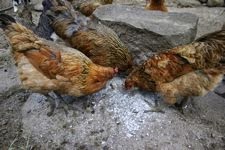
In our quest for a leaner and healthier yolk, we have decided that just feeding the chickens good food wasn't enough, they need to exercise to aid their digestion, and to pump all the nutrients in their blood around their bodies. When a chicken feeds from a feeder, they feed until their gullet is full and then they just hang out, digest some, and poop a lot.  But when they eat in the wild, they peck once and scratch twice, repeatedly, all day long. Eating this way causes the chicken to eat more slowly and the constant exercise provided by all that scratching means that the chicken is better able to better utilize the food they eat. 
We decided to stop feeding the chickens in bowls, or even simply scattering grains on the bare ground. What we are doing now is taking a bag of mixed grains and seeds into the forest to scatter among the fallen leaves, moss and grasses. The chickens seem to get almost all the grains. (what they don't find should sprout, the grains are even better when they sprout.)
We have been throwing the seeds out in the woods for the chickens. We feed them in a random rotation to keep them from over scratching any one area of our property.

The chickens are actually requiring less seed overall, because they are getting more moss and other forest goodies along with the grains we throw, there has been a rise in egg numbers, the shells are firmer, and the yolks are darker and more translucent, and therefore less fatty.

Egg Shooters
We also noticed that the chickens seem to be having an easier time laying, because they are all spending less time sitting in the nests, they just hop up lay, and move on. Perhaps all the work spent scratching in the woods is toning up their egg shoving muscles.

Sunday

Alfalfa, to Nourish and Entertain your Chickens

Our chickens like to forage into the woods find their greens.  We feed our chickens a lot of seeds and grains, but in hot weather we pull back on the corn because of the sugar content, but there are a still lot of calories in grains, and also grains rank pretty acid on the food pH.charts.
High calorie, acid producing foods like grains meat or dairy tend to "anger the blood" and make it harder to deal with heat in summer, the chickens also tend to get irritable and short tempered when they are eating too much acid producing foods.
Leafy greens tend to be more alkaline in the food pH. charts  (greens are chock full of minerals). The chickens need some leafy greens to balance out their pH. levels while feeding on grains
However with the hotter drier weather they have been going deeper into the forest as things dry out to find their greens.  At the same time the raccoons have been coming closer to the house in search of food, and finding eggs and chickens occasionally. 


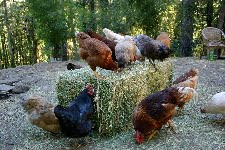
Alfalfa is full of dried green leaf, and the chickens will eat it straight off the bail.  By watching the chickens we can see that they like alfalfa more than they like hay. As it turns out, alfalfa has a pH. value of ten meaning that is quite alkaline. We noticed that the chickens all mellowed out today after snacking on alfalfa for awhile.
While the chickens loose interest in the straw and even the hay, the alfalfa bale is like a magnet attracting chickens to it's self, all day long we see a rotation of chickens scratching and pecking the top of the bale. Other chickens walk around the bale browsing around the edges of the bale, and eating the alfalfa flakes that get scratched off onto the ground by the upper chickens. 

Alfalfa is a very nutritious food crop. Alfalfa sends it's roots deep into the soil. One of the reasons that farmers use it in their crop rotation is because the shorter rooted crops can use up the surface nutrients, but alfalfa's long roots will pull nutrients to the surface from the deeper soil. 

Alfalfa Contains:

18% Protein

Vitamin A (beta carotene), Calcium (More than Milk or Eggs by weight)
phosphorus, Vitamin E, Potassium, Chlorine, Vitmain B1, Vitmain B2, Vitmain B6, Vitmain B12, Vitamin K, Niacin, Folic Acid, S-Methylmethionine, Magnesium, Copper, Biotin, Sulfur, Cobalt, Boron, Panthothanic acid, Inocitole, Molybdenum, and trace amounts of: Nickel, Strontium, and Palladium


We used to use alfalfa pellets to supplement the chickens diets, by soaking the pellets overnight and feeding it to the chickens in bowls. They would eat up the soft dark green alfalfa mash all at once during feeding times, but we wanted to provide a source for  them to nibble on throughout the day, so the hens could digest it better along with the other foods they eat. Putting alfalfa bales in the yard allows the chickens to feed themselves.


Here is the same bale after a few days of chicken pecking.


Our next plan is to get a few more bails to put in the coops. We hope that having alfalfa bales within the coops might keep the chickens occupied in the mornings, instead of squawking at us to hurry up, wake up, and let them out.


Chickies like Alfalfa Too!:
chickie casserole
 We are giving our new chickies free choice alfalfa in a baking dish, the alfalfa dish is very popular and the chicks seem to spend more time in it than in their food dish!  Sometimes they even sleep there.


Winter Update:

It is now wet and rainy, so leaving a bale of alfalfa out in the weather is not a great idea,  but the chickens really enjoy eating nice dry alfalfa powder when everything else is wet.
We serve alfalfa to the goats, in a box. but we only give them the chunky leaf and stems, because the powdery alfalfa leaf tickles the goats noses making them sneeze.  We collect the finer alfalfa that is left in the bin after picking out what we feed to the goats, and distribute it to bowls in the yard and in the coops for the chickens to eat.  It works very well for the chickens because the stems are too big for them to swallow and just get in the way of the leafy alfalfa powder, which is what they prefer.


Alfalfa Pendulums

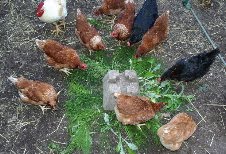
 We wanted to give the chickens some alfalfa in the coops, since it is still raining out, and they are having a lot of indoor time during rain showers.  We decided to hang a block in each coop by wrapping it in a net and hanging it from the ceiling with some old t.v. cable we had laying around.

Hanging the alfalfa up off the ground keeps it dry, and they can clean around under the block.
Eating off a moving pendulum keeps the chickens exercised, and it is entertaining for us to watch.
It feels good to know they can get their greens even when it is nasty out, we will keep these alfalfa pendulums available as a free choice option for the hens, they will use it on nice days too, and in the mornings while they are in the coops, segregated from the raccoons and hawks.
 
 Summer pool fun, with alfalfa!
The cement pond is a nice way to  contain loose alfalfa in the summer, the alfalfa stays in the bowl and gets scratched finer and finer until it is all eaten. 
Everybody has a nice time 
 
and then . . .
 Rue Dee and Happee pitch in and help.
 and then rest. 
 
 
We always put out plenty of water, because eating all that alfalfa has got to make them really thirsty. 


Friday

Mixing up the Vitamins


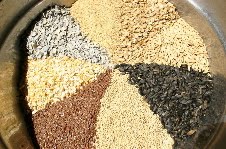
Chickens enjoy this wonderful seed and vegetable mix.
This batch included roasted acorn squash and pumpkin rinds.


Some of the other foods that we provide to our chickens include:

Alfalfa
Beet Pulp
Whole Barley
Cracked Corn
Flax Seed
Millet
Rolled Oats
Oyster shell
Sea Weed (Kelp Meal)
Soy Bean Meal
Sunflower Seeds
 Garden Vegetables,
Fish Meal and Kelp Broth

Check here for more about the Seedy Eggs.

Wednesday

Educating your baby chicks about forest dirt.

 
 Spring is around the corner, and people will be starting their flocks by bringing baby chicks home from the farm store.   Chickens when raised by humans lead a rather sheltered existence, when compared to hen raised chicks. Humans do a fine job of taking care of the basic needs of chicks like food and shelter, but what of the educational needs of your chicks, while they are living inside of a pen?  
A chick in a pen usually has a floor of pine shavings or straw which makes a nice floor to walk on and manage the droppings, but is still a fairly bland, and sterile environment for the chicks educational development.
  
 In our woods we found an old hollow oak tree trunk that had recently fallen, inside the trunk was dirt made up of over a hundred years of rotting wood, generations of dead bugs,  fungi, and old leaf matter.  
  
 We collected this black dirt, mixed it with rich soils and mosses from around the bottoms of oak trees,  and put them in roasting pans to introduce the chicks to all the stuff that they will encounter when they get old enough to graduate into the real world outside.   They get a chance to scratch, taste, smell, and roll in the stuff in the roasting pans, they really enjoy the change of scene. 
 Finding ways to enhance the environment of baby chicks, while they are in confinement, by using dirt trays or adding mossy branches for the chicks to play in, or nibble on, just seemed like a sensible thing to do.